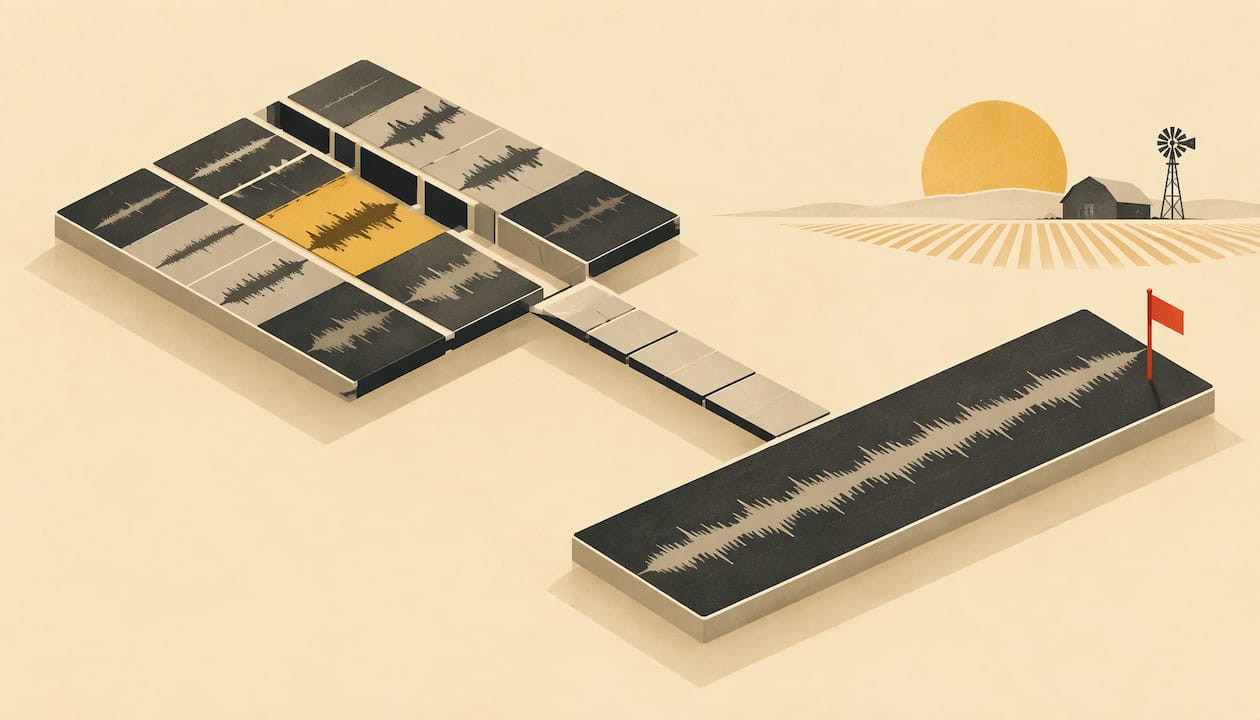
Music editing is the cleanup step between recording and mixing. An editor picks the best takes, removes noise, tightens timing, fixes pitch and organizes the session so the mixing engineer starts with a clean, usable project. Done well, you never hear it. At The Fields Recording Studio in Lincoln, Nebraska, editing and cleanup, vocal tuning, mixing and mastering sit under one roof, so the same studio that captures your vocals can prepare them for the mix and deliver the finished files.
This guide explains what editing covers on vocals, instruments and full songs, where it ends and mixing begins, what slows it down, and what to prepare so you get more from every hour you book.
TL;DR
- Music editing selects and cleans recorded performances. It comes after recording and before mixing, and it fixes timing, pitch and unwanted noise.
- Good editing is invisible: the listener hears the performance, not the cuts.
- Quality depends on what was recorded. Strong takes and a clean capture give an editor far more to work with.
- Before you book, agree what is included (editing, tuning, timing), how many revisions you get, the turnaround and the file formats you receive.
- The Fields offers editing and cleanup, vocal tuning, mixing and mastering, and delivers WAV, streaming-ready, radio, instrumental and clean versions.
Table of Contents
- What music editing services actually include
- How editing differs from recording, mixing and mastering
- Editing vocals
- Editing instruments and full songs
- What decides the quality of an edit
- How editing fits into a session for rap artists and bands
- What to prepare and agree before you book
- Why one studio for editing, mixing and mastering
- Book editing with The Fields
- FAQ
- Sources
What music editing services actually include
People search for music editing and audio editing services and get very different things: video-sound libraries, software, even proofreading. In a recording studio, editing means one specific job: working on the raw recorded audio of a song before it is mixed.
Avid's music-production guide places editing after arrangement and before mixing. It describes the work as reviewing recordings, selecting takes, removing unwanted audio, and correcting pitch and timing. In practice that breaks into a few tasks:
- Comping. Combining the best parts of several takes into one master performance.
- Cleanup. Removing clicks, plosives (the bursts of air on "p" and "b" sounds) and background noise.
- Timing correction. Tightening a performance that drifts against the beat or the rest of the band.
- Pitch correction. Tuning notes that wander, used as much or as little as the song calls for.
- Session preparation. Labeling tracks, aligning files and leaving a project the mix engineer can open and understand at once.
The Fields lists editing and cleanup and vocal tuning as separate services alongside vocal tracking, small instrument tracking, mixing and mastering, so you can book the pieces your project needs.
How editing differs from recording, mixing and mastering
The four stages get blurred together, and that is how people end up paying for the wrong thing. Here is how they separate.
| Stage | What happens | Main question it answers |
|---|---|---|
| Recording | Capturing vocals and instruments as audio | Did we get strong performances with a clean signal? |
| Editing | Selecting takes, removing noise, fixing pitch and timing | Is every part usable and in place? |
| Mixing | Combining tracks into one stereo file | Do all the parts sit together? |
| Mastering | Final tonal, level and format preparation | Will it hold up on every system and platform? |
Yamaha's Mike Levine describes the split the same way: recording captures parts, mixing combines multitracks into a stereo or mono file, and mastering handles final tone, level and the delivery medium. He adds that mastering can address delivery levels for streaming, vinyl or CD, and that album mastering also considers track order and spacing for physical formats.
Editing is the quiet stage in the middle. It is surgical rather than creative: cutting, sliding, fading and muting so the performance sounds natural. If it is skipped or rushed, the mix engineer ends up solving problems that should have been handled earlier, and every fix costs time and often some of the song's feel.
Editing vocals
Vocals are where most editing time goes, especially for rap artists and singers who record several passes of each section.
Comping: building one performance from many
Sound On Sound's Mike Senior describes vocal comping as selecting and editing the strongest sections from several takes into one master vocal. The edits can be hidden in silences, breaths and consonants, with short crossfades smoothing each join, and pitch correction can be added when it is needed.
What separates a good comp from a bad one is matching. Recording Magazine's vocal guide says selections should match not only technical qualities such as mic position, room tone and level, but also vocal character, inflection and interpretation. A line that is technically clean but delivered with a different attitude will stick out.
Breaths, plosives and sibilance
Cleanup is where a heavy hand does damage. Sound On Sound's Paul White notes that stripping out every breath makes a vocal sound unnatural; loud breaths can be reduced with gain changes, automation or restrained gating instead. Tape Op's Larry Crane says track preparation can include removing clicks, plosives and unwanted noise, but warns against cutting off natural breaths or word fragments.
Sibilance, the sharp "s" and "t" sounds, can often be tamed early. Sound On Sound's Robin Freeman suggests adjusting clip levels and excessive breaths before dynamics processing, and notes that sibilants can sometimes be reduced with clip gain before any further processing.
Tuning
Vocal tuning is its own decision, not an automatic extra. Some styles want transparent correction that nobody notices; others want a hard, audible effect. Tell the engineer which you want before the work starts. The Fields offers vocal tuning as a distinct service, so you can settle that choice up front rather than discovering it at the mix.
Editing instruments and full songs
The same logic applies beyond the voice. On guitars, keys, percussion and other small-instrument parts, editing removes handling noise, string squeaks and stray sounds between phrases, and lines up parts that drift against each other.
For a complete song, editing also covers arrangement housekeeping: moving, duplicating or trimming sections, checking that every part starts and ends where it should, and leaving the session labeled and organized. Mark Rankin, quoted in MusicRadar's 2024 mixing tips, organizes sessions by instrument group, labels tracks and adds section markers to move efficiently through a song. A tidy session is not cosmetic. It lets the mix engineer spend the hours on sound instead of on hunting through unnamed tracks.
The Fields offers small instrument tracking, so instruments recorded in the studio can go through editing and cleanup and then into the mix without leaving the building.

What decides the quality of an edit
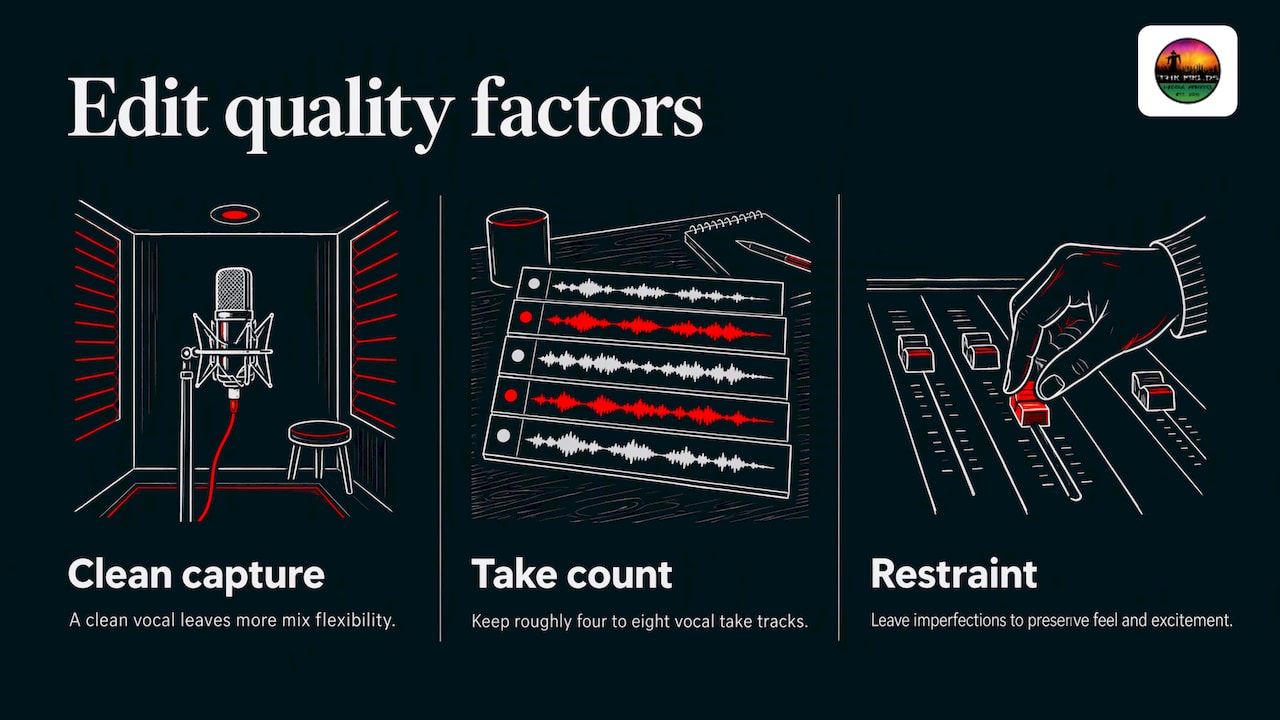
Editing can improve a recording a lot, but it cannot invent what was never captured. Three things decide how good the result is.
1. The capture. Recording Magazine and others make the same point: editing has more room to work when the original recording is clean. MusicRadar quotes engineer Rhiannon Mair preferring a minimally reflective space and a dry, natural vocal capture, because it leaves more flexibility in the mix. A vocal full of room echo or noise is hard to rescue later, which is why clean signal capture at the start matters. The Fields describes its approach as built on clean signals and rhythmic integrity.
2. The number of takes. More takes is not always better. Mike Senior recommends keeping roughly four to eight vocal take tracks, balancing enough material to choose from against the time it takes to review everything. Too many takes stretch turnaround without improving the result.
3. Restraint. Recording Magazine cautions that ever more detailed editing reaches diminishing returns, and that leaving some imperfection can preserve feel and excitement. Tape Op's Larry Crane makes the matching point that excessive cleanup can remove useful performance details. The target is a performance that feels alive, not a grid-perfect one.
How editing fits into a session for rap artists and bands
Rap artists
Rap sessions often start from a finished beat. Yamaha notes that hip-hop and EDM often use programmed loops or MIDI rather than live tracking, which means the vocal is usually the main thing recorded and edited. That puts weight on how the vocal is tracked.
Two habits from published studio practice help. Mike Senior recommends recording vocals in song sections when useful, which can reduce edits between fresh and tired performances. And a Sound On Sound account of a lead-vocal session says limiting takes and agreeing on punch-in and audition procedures makes overdubbing and communication smoother. A punch-in means re-recording just one line or word and dropping it into the existing take.
For what happens after the edit, our own notes on mixing aggressive rap vocals over a two-track beat cover how a cleaned vocal sits against a beat that arrives as a single stereo file.
Bands
For bands, the main efficiency gain is in the plan. Yamaha says studio live tracking works best with enough microphone isolation to limit bleed, meaning the sound of one instrument leaking into another's microphone. Less bleed means each part can be edited on its own without dragging the rest of the band with it.
Bring a band that has rehearsed to a tempo and arrangement, and editing becomes a light touch instead of a rescue. Rehearsal time is cheaper than editing time.
Commit when you can
Robin Freeman advises making some decisions during tracking and keeping alternatives in a muted folder inside the project, rather than deferring everything until mixdown. Choose the main vocal, keep the doubles you might want, and move on.
What to prepare and agree before you book
Most disappointments with editing come from unspoken assumptions. Settle these before the first session.
- Scope. Is editing, tuning and timing work included, or quoted separately? Tape Op's guide to working with a mix engineer suggests agreeing exactly this, along with costs, turnaround, revisions and deliverables.
- Your own edits. If you have already made edits, make sure crossfades are clean and files are aligned. Larry Crane says clearly prepared edits and crossfades can save the mix engineer time.
- Sounds to keep. If a distortion, a rough breath or a vocal crack is intentional, say so. Otherwise cleanup may treat it as a flaw.
- Revision notes. Keep them short and specific: a time stamp and a request beat a general feeling.
- Delivery formats. Decide whether you need a WAV master, a streaming-ready file, a radio version, an instrumental or a clean version, so nothing is requested at the last minute.
With The Fields, that last list matches what the studio delivers: WAV, streaming-ready, radio, instrumental and clean versions. Because the mix and master are done by the same studio that edited the tracks, the files you approve are the files you release.
Why one studio for editing, mixing and mastering
Each stage limits the next. A vocal recorded with heavy room noise cannot be fully rescued by editing, and a mix with colliding low-mid frequencies cannot be fully repaired in mastering. That chain is the reason decisions made early matter so much to the final sound.
Keeping tracking, editing, mixing and mastering together removes the handoffs where intent gets lost: no files exported in the wrong format, no notes that never reach the next engineer. The Fields positions its sessions as efficient and structured, built for artists who want a focused workflow without major-label-style theater, and its mixes and masters are designed to translate across earbuds, cars, clubs and radio.
Book editing with The Fields
The Fields Recording Studio, founded in 2019 in Lincoln, Nebraska, offers editing and cleanup and vocal tuning, alongside vocal tracking, small instrument tracking, mixing and mastering, for musicians, rap artists, bands and producers, local and from outside Lincoln. No prices are published on the site, so the way to get a quote is to describe your project: how many songs, what is already recorded, and which deliverables you need.

See the full list of services and get started on the Lincoln recording studio page, or browse the studio's home page. For more on recording, mixing and mastering practice, the Fields audio blog has working notes.
FAQ
What is the difference between music editing and mixing?
Editing works on individual recorded parts: choosing takes, removing noise and fixing pitch and timing. Mixing then combines all the tracks into one stereo file and balances them. Editing prepares the material; mixing shapes how it sounds together.
Can editing fix a bad recording?
It can fix many small problems, such as clicks, timing slips, a flat note or a weak line replaced from another take. It cannot fully remove heavy room noise or add a performance that was never captured. Clean, well-gained recordings give an editor the most room, so start with a good capture.
Do I need vocal tuning on every song?
No. Tuning is a stylistic choice. Some songs call for subtle correction, others for an obvious effect, and some need none. Tell the engineer which you want. The Fields offers vocal tuning as its own service, so you only add it where the song needs it.
How long does music editing take?
It depends mainly on how much material there is to review. Sound On Sound's Mike Senior suggests keeping about four to eight vocal take tracks, since a pile of takes lengthens the time spent choosing. Agree a turnaround with the studio when you book.
What files will I receive after editing, mixing and mastering?
At The Fields, deliverables include WAV files, streaming-ready versions, radio versions, instrumentals and clean versions. Tell the studio which ones you need before the work begins.
Sources
- Music Production: A Complete Guide, Avid
- Recording Basics: What's the Difference Between Recording, Mixing and Mastering, Yamaha
- Vocal Comping & Editing, Sound On Sound
- Vocal Recording & Production Masterclass, Sound On Sound
- 36 Tips For Budding Engineers & Producers, Sound On Sound
- Session Notes: Tracking Lead Vocals, Sound On Sound
- Working With a Mix Engineer, Tape Op #158
- Mixing tips and production advice from the pros, MusicRadar
- Vocal Recording for Songwriters, Recording Magazine